

Stepmom Over-Functioning: Why Doing More Is Keeping You Stuck
You're exhausted, you're carrying everything, and somehow it's still not enough. Here's why.

Every coffee bought by this community helps me create more content just like this.
Thank you for being here. Buy Me Coffee :)
Does anyone see how much I'm carrying?
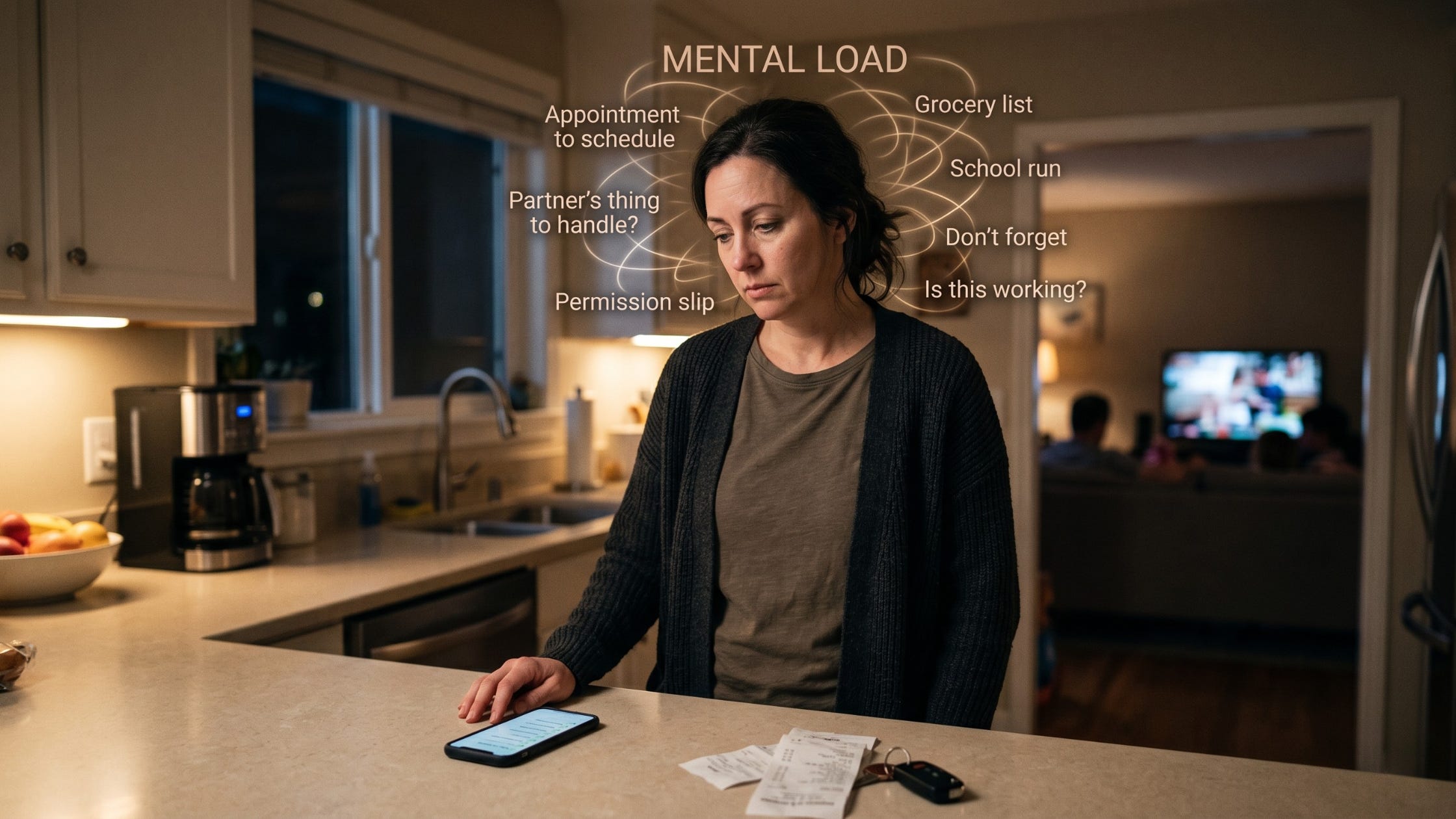
It’s a Wednesday night.
Dinner is done — you made it, you cleaned it up — and you’re standing at the kitchen counter running through tomorrow in your head. Permission slip for the youngest. Appointment you need to reschedule. The thing your partner forgot to follow up on that you quietly handled yourself so it didn’t fall apart.
No one asked you to track any of this. You just do.
Somewhere in the next room, the TV is on. The kids are settled. Your partner is decompressing. And you are standing at the counter at 8:47pm, alone with a mental list that belongs to everyone and to no one.
You are not angry — not exactly. You are something harder to name.
Tired, yes. But underneath the tired is a question you keep not quite asking: does anyone see how much I’m carrying?
You didn’t become the person who does everything because you wanted to. You became her because the gap was there — and you were the person who noticed.
That's the beginning of the over-functioning loop. And if you've been living inside it for a while, this article is for you.
How the Loop Starts
It doesn’t begin with resentment. It begins with love, or practicality, or simply being the kind of person who notices when something needs doing.
You stepped into your stepfamily and you saw the gaps. The kids needed someone to remember things. Schedules needed managing. The emotional temperature of the house needed monitoring. You were capable, you were present, and no one was doing it. So you did.
And then you kept doing it, because the gap stayed open.
Over time, “I’ll handle this” became the architecture of your life in this family. Not because anyone explicitly asked you to — but because the system adapted around your effort. You filled the space, and the space stayed filled, and everyone got used to it being filled by you.
The loop looks like this:
You do more because the gap is real and no one else is stepping in
Others do less, because you’ve reliably handled it
You feel unseen and undervalued, so you do more to compensate
The cycle repeats
The exit from this loop is never more effort. It’s interrupting the pattern. But to interrupt it, you first have to see it clearly.
What It Costs You Beyond Exhaustion
The exhaustion is real and it’s worth naming. But there’s something underneath the tiredness that’s harder to talk about.
When you’ve been functioning as the person who holds everything together for long enough, something shifts. You stop being a person with needs and preferences and interests of your own. You become a function. The one who tracks, manages, anticipates, smooths.
And when that contribution goes consistently unacknowledged — not because the people around you are cruel, but because the system has adapted around your effort and no longer sees it as effort — something starts to close down.
You stop expecting to be seen. You stop asking. You tell yourself it’s fine, or that this is just what it is, or that you’re being unreasonable for wanting more.
But you’re not being unreasonable. You’re responding to a dynamic that has taught you, over and over, that your effort is expected and your needs are optional.
The effort and the recognition are not automatically connected.
Doing more does not create visibility. It creates an expectation.
That distinction matters. Because as long as you believe the solution is to do more — to prove your worth through contribution — you will stay in the loop. The doing more is both the symptom and the thing that keeps the symptom in place.
The Thing Nobody Tells You About Doing More
Here’s what no one warned you about when you stepped into this role: doing more does not create connection. It creates an expectation.
Once you’ve established yourself as the person who handles things, the system adapts. The kids expect it. Your partner expects it. You have become the infrastructure. And infrastructure, by its nature, is invisible until it breaks down.
This is the trap that is so hard to see from the inside.
You are not stuck because you’re incapable of change. You are not stuck because the people around you don’t love you. You are stuck because the pattern has become the water you swim in. It is normal now. It is just how things are.
Changing it requires something that feels almost counterintuitive: not more effort, but less. Not more proving, but less compensating. Not a conversation that demands recognition, but a different kind of honesty — about what you’re actually responsible for, what belongs to someone else, and what has quietly become yours by default without anyone agreeing to it.
Where This Points
If you read any of the above and felt something land — a quiet recognition, a little tightness in the chest, the sense of being seen in something you haven’t said out loud — I want you to know that this is not just your personality or your circumstances.
This is a pattern. It has a name. And it can change.
The first step is not doing less. It’s getting honest about what your role in this family actually is — and what it isn’t. That conversation hasn’t happened for most stepmoms. Not because they’re avoiding it, but because no one told them it was a conversation worth having.
It is. And that’s where this month is headed.
The Wednesday night kitchen counter version of you — the one standing there at 8:47pm with everyone else’s list in her head — she deserves more than a better coping strategy. She deserves a different structure.
We’re going to build that.
Not sure what’s driving your exhaustion? The quiz takes 3 minutes and helps you understand which part of the stepmom role is actually draining you.
You might also find these helpful:

You're Not the Problem—The Structure Is

If you’ve ever wondered why stepfamily life feels so much harder than you expected, let me offer you some relief:
Burnout Isn’t Just Exhaustion — It’s a Boundary That’s Been Ignored

There’s a kind of tired that no nap can fix.
The Invisible Work of Trying to Belong

There’s a particular kind of exhaustion that comes with stepfamily life—and most people never see it.
“If I don’t do it, it won’t get done”…or it won’t get done right…
And that's the hard part, in deciding if that task really needs to be done and if not, what will happen.